
Auto Body Invoice Template
Download free auto body invoice templates for Word & Excel. Create professional collision repair invoices in under 60 seconds with paint & VIN tracking.
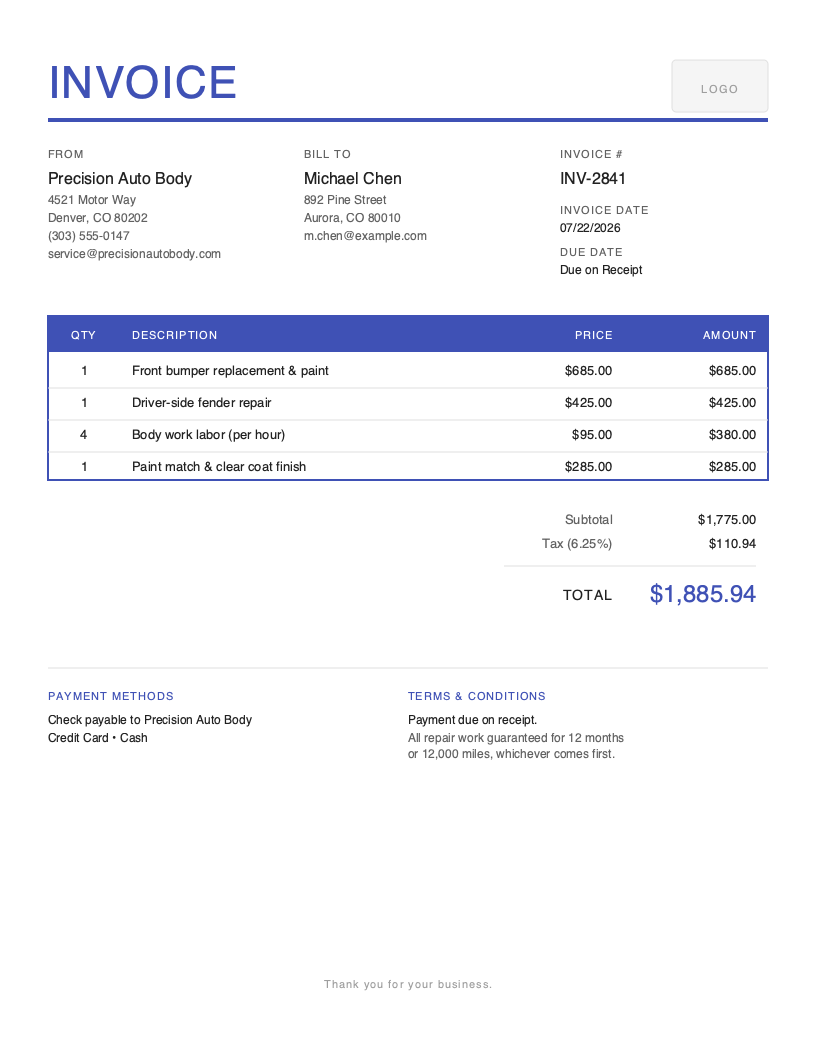
Download Free Auto Body Invoice Template
Get Your Free Auto Body Invoice Template
Download in your preferred format. Customize with your logo, colors, and business details. Start invoicing professionally in minutes.
Microsoft Word
Easy to customize, add your logo
Microsoft Excel
Auto-calculate totals and taxes
Auto Body Invoice Template Variations
Choose from multiple professional designs. Customize colors, add your logo, and make it yours.
Default
Clean default layout
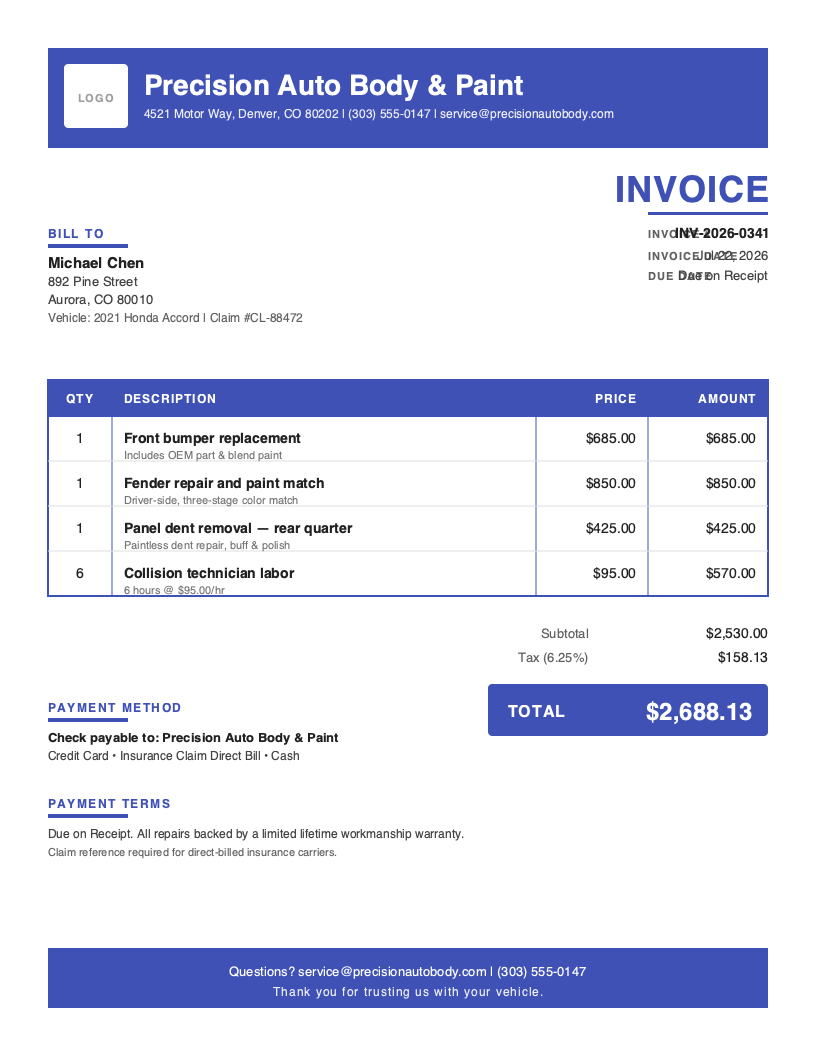
Bold
Branded, high-contrast header
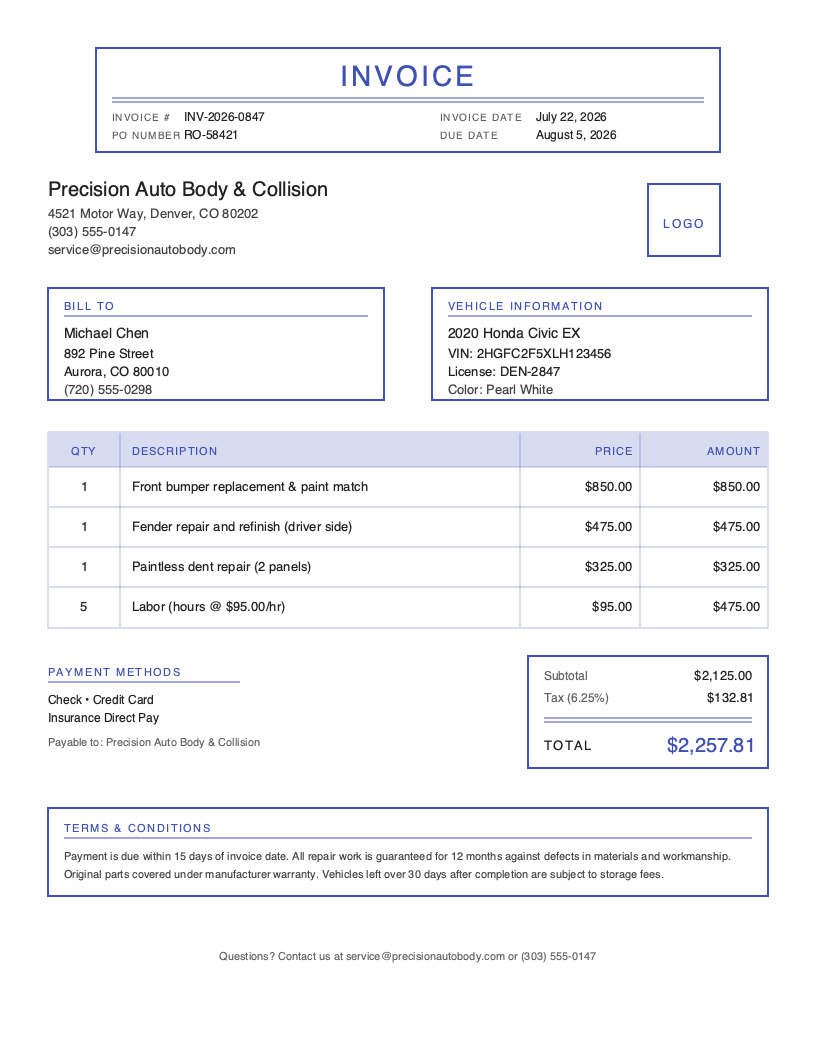
Classic
Traditional professional layout
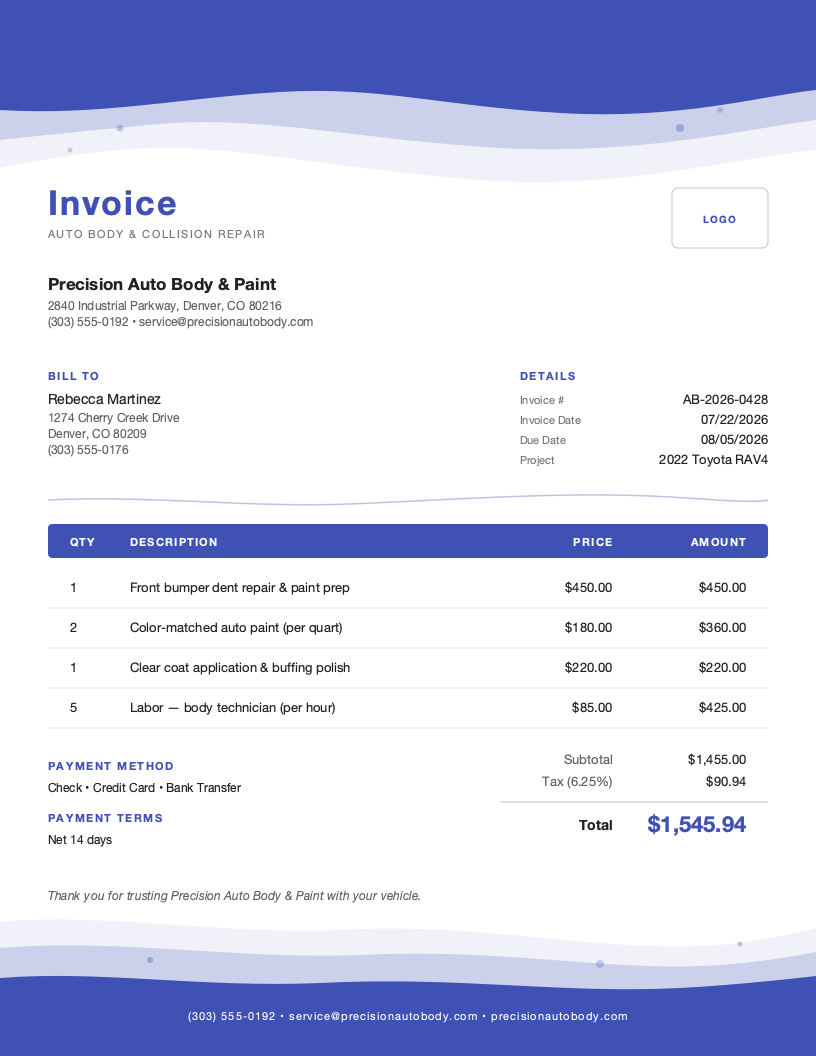
Artistic
Eye-catching color accent
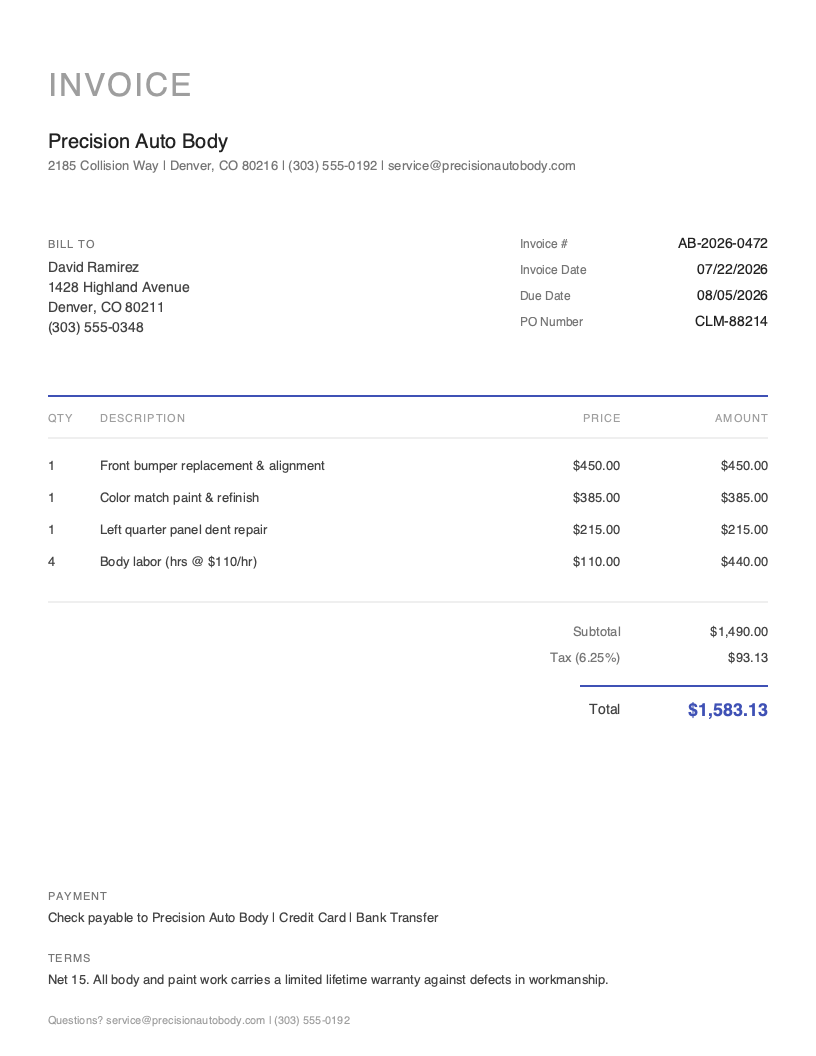
Minimal
Clean, utility-first design
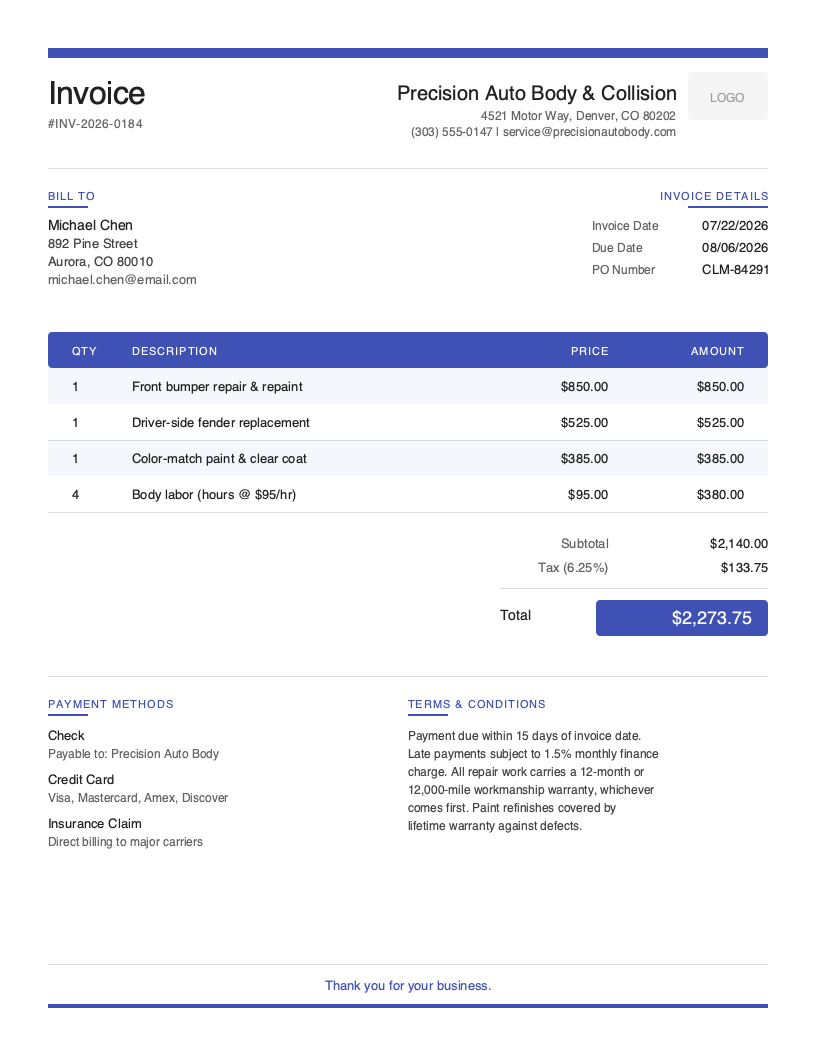
Modern
Clean, contemporary look
No signup required. Create and download instantly.
The car has been in your bay for two weeks. You have replaced a quarter panel, pulled the frame back to spec, blended three panels of paint, and coordinated four supplements with the insurance adjuster. The customer is picking up in an hour, and now you have to build an invoice that makes sense to them, the carrier, and your bookkeeper—all at the same time.
That is the reality of auto body invoicing. Every repair is a three-party transaction between the shop, the customer, and an insurance carrier who scrutinizes every line. Weak documentation is the single biggest reason collision shops leave money on the table—in underpaid supplements, denied paint hours, and disputes that drag out for months.
Auto body invoices are not auto repair invoices. You need paint codes, refinish hours, frame measurements, OEM parts designations, supplemental damage records, and a clean split between insurance-paid and customer-paid amounts. Generic templates simply were not built for this.
What You’ll Find on This Page
- Free downloadable auto body invoice templates (Word & Excel)
- Complete breakdown of every element a collision repair invoice needs
- Industry statistics and how insurance work reshapes billing
- Best practices for faster carrier payments and cleaner supplements
- How to create auto body invoices in under 60 seconds from your phone
Download Free Auto Body Invoice Templates
Both templates are formatted for collision repair, with dedicated fields for paint codes, insurance claim numbers, deductibles, and OEM/aftermarket part designations. The Excel version includes built-in formulas that separate body labor, paint labor, and frame labor at different rates, then roll them up alongside parts, paint and materials, and tax—so your totals stay accurate even when you rewrite lines on the fly.
What to Include on Your Auto Body Invoice
A collision repair invoice does three jobs at once: it documents the work for the customer, satisfies the carrier’s paper trail requirements, and protects your shop if a claim is disputed months later. Missing fields cost real dollars.
Required Invoice Sections
Invoice Header - Invoice number, repair order (RO) number, date, shop logo, and any I-CAR Gold Class or manufacturer certifications for professional identification.
Business Information - Shop name, address, phone, DRP (Direct Repair Program) affiliations, and state body shop license number.
Client Information - Customer name, address, phone, email, and insurance policy details.
Vehicle Information - VIN, year/make/model, mileage, license plate, exterior color, and OEM paint code.
Insurance Claim Details - Carrier name, claim number, adjuster contact, and authorized estimate total.
Line Items - Parts, body labor, paint labor, frame labor, and paint and materials listed separately.
Pricing Summary - Subtotals for parts, each labor category, and paint and materials, plus supplement totals.
Tax Information - Sales tax on parts and taxable materials (rules vary by state) for legal compliance.
Payment Methods - Insurance direct pay, deductible collection at delivery, and financing for uninsured work.
Terms & Conditions - Paint match and workmanship warranty, storage fees, and lien rights for legal protection.
Critical Auto Body Invoice Elements
Paint Code and Color Match Notes - The OEM paint code from the door jamb sticker is non-negotiable. Note whether you used a straight code, variant deck, or blended into adjacent panels. This is your defense if the customer returns claiming a color mismatch six months later.
Insurance Claim Number and Supplements - Every supplemental discovery gets its own line with the date approved and adjuster name. When the carrier’s payment arrives 45 days later, you can reconcile it against the invoice line-by-line without a phone call.
Frame and Structural Measurements - If you pulled the vehicle back to factory spec, include the pre-pull and post-pull measurements or a reference to the frame machine printout attached to the RO. Structural work drives higher labor rates and needs to be defensible.
Betterment and Deductible Line - Show the total repair cost, subtract any betterment (customer contribution for improved parts, like a new tire replacing a worn one), then the insurance-paid amount, then the deductible owed at pickup. Clean math prevents delivery-day arguments.
Understanding Auto Body Business Invoicing
The U.S. collision repair industry generates roughly $45 billion in annual revenue across more than 40,000 shops. Unlike mechanical repair, over 80% of collision work is paid by insurance carriers, which reshapes how you invoice and how long you wait for payment.
Independent Collision Shops - Family-owned and single-location shops that live and die on DRP relationships and clean estimates. Professional invoicing directly determines how much of the estimate the carrier actually approves.
MSO (Multi-Shop Operators) - Regional and national chains with centralized billing systems and volume DRP contracts. Their invoicing standards set the bar for the entire industry.
Specialty and Restoration Shops - Classic car restorers, high-end paint specialists, and dent-only PDR (paintless dent repair) shops. These operations lean more on cash-pay customers and need invoices that read as premium services, not commodity repairs.
Auto Body Invoicing Best Practices
Write Line-Item Estimates Before You Start
Insurance carriers require a written estimate before authorizing repairs, and that estimate becomes the backbone of your invoice. Break every operation into its own line—R&I (remove and install), R&R (remove and replace), refinish, blend—so supplements later on are easy to justify against the original scope.
Document Paint Codes and Refinish Steps
Record the OEM paint code, any tint variant used, and every refinish stage: prep, sealer, base coat, clear coat, and blend panels. This documentation protects your color-match warranty, supports the refinish labor hours you billed, and helps if the customer’s next body shop needs to reference the work.
Photograph Every Stage of the Repair
Take teardown photos before you order supplemental parts, in-progress photos during frame and body work, and finished photos before delivery. Attach them directly to the invoice record. Insurance adjusters approve supplements faster when the evidence is already in front of them, and customers rarely dispute charges they can see documented.
Separate Body, Paint, Frame, and Mechanical Labor
Each labor category carries a different rate and, on DRP jobs, different carrier approval. Body labor might bill at $65 an hour while frame labor bills at $90 and mechanical at $110. Combining them on one line invites the carrier to pay the lowest rate across the board—so keep them separate, always.
Track OEM vs. Aftermarket vs. LKQ Parts
Label every part as OEM, aftermarket, or LKQ (like-kind-and-quality recycled). Customers and insurers have the right to know what is going on the vehicle, and some states legally require the disclosure. This transparency also lets you defend a higher parts price when the carrier tries to substitute.
Offer Insurance Direct Pay and Clear Deductible Collection
The faster the carrier can pay you, the faster your cash flows. Set up direct deposit with major carriers through your DRP relationships. On the invoice, show the deductible as a separate line the customer pays at pickup—cash, card, or financing—so there is no confusion at delivery.
Include Supplement History on Every Invoice
Every collision repair involves discovery. Track each supplement with a date, adjuster name, and approved amount, and roll them into the final invoice as visible line items. This creates the paper trail that gets you paid the full authorized amount without a fight.
Create Auto Body Invoices in Under 60 Seconds
Templates get you started. But the moment you have 12 open ROs, three carriers to bill, and a customer walking in for pickup, manual invoicing becomes a liability. Every minute at the desk is a minute you are not writing the next estimate.
Pronto Invoice was built for auto body shops that invoice between deliveries, not accountants at a desk. Our mobile-first approach means you create carrier-ready invoices from your phone in five simple steps:
- Select Client - Pull from saved customers or add new ones in seconds
- Add Line Items - Parts, body labor, paint labor, frame labor, and paint and materials with automatic calculations
- Set Payment Info - Insurance direct pay, deductible amount, and delivery date
- Add Vehicle Details - VIN, mileage, paint code, and claim number fields built-in
- Review and Send - Email to the carrier and text the customer instantly
Features Auto Body Shops Need
Offline Capability - Body shops sprawl across bays, prep booths, and paint booths where cell service dies. Pronto Invoice works completely offline—create and save invoices from anywhere in the shop, and they sync when you reconnect.
Multi-Rate Labor Tracking - Set separate rates for body, paint, frame, and mechanical labor once, then apply them to line items with a tap. Rolls up cleanly on the totals so the carrier sees exactly what they authorized.
Photo Attachments - Attach teardown, in-progress, and finished photos directly to the invoice. Document supplemental damage, color matches, and completed work for your records, your customer, and the adjuster.
Payment Reminders - Automated reminders follow up on deductibles and cash-pay balances so you can focus on repairs, not collections. Customers can pay their deductible directly from the invoice via credit card or ACH.
QuickBooks Integration - Professional tier includes real-time QuickBooks sync. Invoices flow directly to your accounting software—no double entry, no reconciliation headaches when the carrier check arrives 60 days later.
Auto Body Invoicing Best Practices
Write Line-Item Estimates Before You Start
Insurance carriers require a written estimate before authorizing repairs. Break each operation into its own line so supplements are easier to justify.
Document Paint Codes and Refinish Steps
Record the OEM paint code, tint variant, and every refinish stage (prep, sealer, base, clear). This protects your color-match warranty and supports refinish labor billing.
Photograph Every Stage of the Repair
Take teardown, in-progress, and finished photos. Attach them to the invoice so insurance adjusters and customers can verify hidden damage and completed work.
Separate Body, Paint, Frame, and Mechanical Labor
Each labor category carries a different rate and different insurance approval. Never combine them on a single line—carriers will underpay.
Track OEM vs. Aftermarket vs. LKQ Parts
Label every part as OEM, aftermarket, or LKQ (like-kind-and-quality). Customers and insurers have the right to know what is going on the vehicle.
Frequently Asked Questions
A complete auto body invoice must include: shop information (name, address, license numbers, I-CAR certifications), customer details, vehicle information (VIN, year/make/model, mileage, license plate, paint code), insurance claim number and adjuster contact, itemized parts with OEM/aftermarket designation, labor broken into body, paint, frame, and mechanical categories, paint and materials charges, applicable taxes, deductible amount, and the customer's authorization signature.
Show the total repair cost, then separately list the insurance-paid portion and the customer's deductible. Most carriers pay the shop directly once the vehicle is picked up, and the customer pays only the deductible at delivery. Keep supplements on a distinct line so the paper trail is clear.
Sales tax rules vary by state. Most states tax parts and paint materials; some tax refinish labor, others do not. 'Paint and materials' is often billed as a flat rate per hour of refinish labor, and that treatment is usually taxable. Check your state Department of Revenue guidelines and show tax as a separate line item.
Related Invoice Templates
Start Creating Professional Auto Body Invoices Today
Join thousands of professionals who use Pronto Invoice to get paid faster. Create your first invoice in under 60 seconds.
This guide is for informational purposes only and does not constitute legal or tax advice.